




“”Hope” is the thing with feathers–
That perches in the soul–
And sings the tune without the words–
And never stops–at all–”
– Emily Dickinson
When all else seems lost, when even justice and prudence and generosity seem far-fetched or far away, we can ever and always turn to hope. And this virtue, which “perches in the soul,” we must never let go of.
Archbishop Desmond Tutu wrote a book on the necessity of hope toward the end of his life, which had, in large part, been spent amid the sufferings and injustices of the South African apartheid. In an interview he gave about his book, he says that hope is not mere optimism. “Optimism,” he says, “is a much lighter thing. Hope is being able to see that there is light despite all of the darkness.” True hope doesn’t ignore the evils, suffering, and darkness. Instead, it says: “there is darkness here, but there also is–and will continue to be–light.”

Without hope, nothing is worth doing. Or, on the flip side, everything good is worth doing if you have hope. Thus, hope must enervate all of the previous virtues and indeed the pursuit of virtue itself. Without hope beyond what we can see now, why would we ever try to become better, truer, more beautiful? And why would we ever believe that we can, even in small ways, help foster a better, truer, more beautiful world? Without hope, why would we ever fight courageously against injustice, discipline ourselves to become more prudent, temperate, and humble, or give away what we have in generosity? Hope carries each virtue forward.
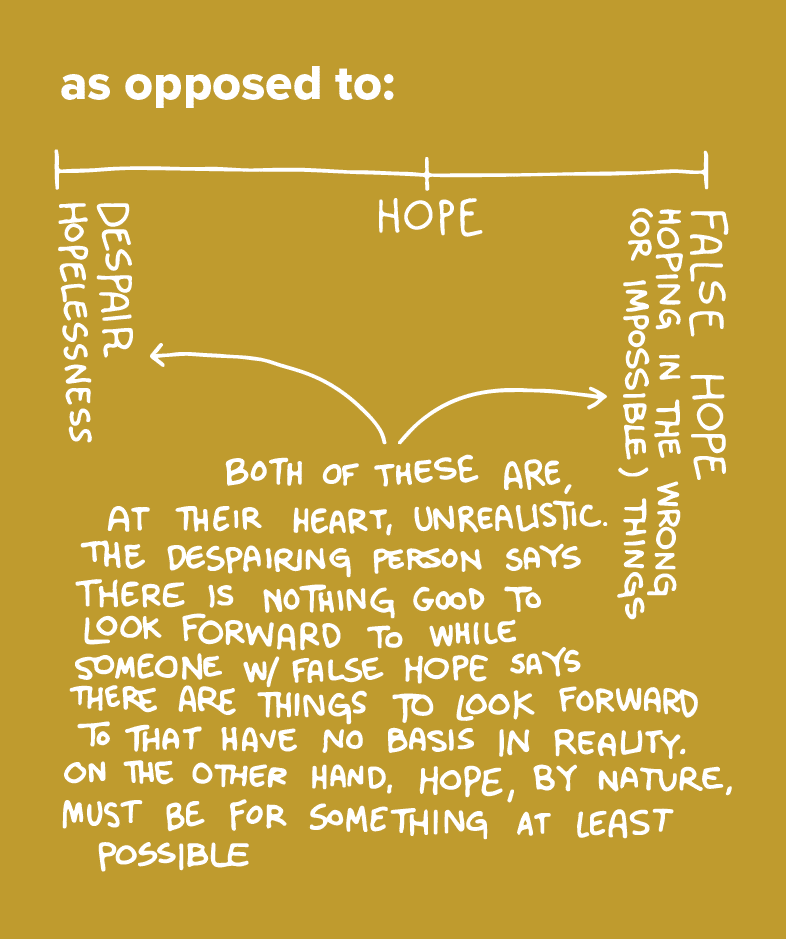
Although most people know by instinct and experience what it means to hope, Aquinas is helpful (as ever!) in providing a detailed definition. Aquinas characterizes hope as having four conditions. In order for it to be hope, it must be:
- For something good
- For the future
- For something difficult
- For something possible
All of this begs the question: for what should we hope? It must be for something in the future that is good and possible, but difficult–but what might that be? This is a question that has been asked over and over throughout history. Indeed, Philosopher Immanuel Kant names “for what may I hope?” as a fundamental question of philosophy. Kant puts forth three general categories of things that people hope for: 1) one’s own happiness, 2) one’s own moral progress, and 3) the moral improvement of the human race as a whole.
With all of these choices out there to put our hope in, the person of virtue must ask: what is the most good, most true, and most beautiful thing I can hope for? What should I put my ultimate, my greatest hope in?
Our hope exemplars–Penelope (from the Odyssey), Don Quixote, and Martin Luther King Jr.–have plenty to say about hope!

Penelope–remaining steadfast and loyal as she patiently waits 20 years for Odysseus’s return. Don Quixote–choosing to see the world not as it is, but as it could be. MLK Jr.–continuing the pursuit of nonviolent resistance through persistent threats, racism, and violence. These are just three examples of incredible people in history and literature who teach us so much about hope. Who is a hope exemplar in your life?
Here is a short (non-comprehensive) list of what hopeful people pursue (for a more robust list, please reference pgs. 45-46 in our Virtues Field Guide).
- Hopeful people intentionally place their hope in something good, future, difficult, and possible.
- Hopeful people patiently wait for and expect what they hope in.
- Hopeful people seek what they hope in.
- Hopeful people see the light despite the darkness.
- Hopeful people hope to the last.




Here’s a short video giving a great overview of hope! Watch with your family to get the conversation going…
For MUCH more on this virtue and others, please check out the Virtues Field Guide in the Parent Portal. In the meantime, let us seek out the most good, the most true, and the most beautiful things to hope in, and let us keep them always close to us, to energize and invigorate us on our way.

1 thought on “the virtues: hope”
Fabulous . Thank you for these.